

A technology unlike any before it?
Raymond James Chief Economist Eugenio J. Alemán discusses current economic conditions.
The motivation for today's report comes from the growing number of articles warning about the possibility of an AI bubble. The truth is that nobody knows whether a bubble exists today in artificial intelligence or whether one may emerge in the future.
What we do know is that AI is a genuinely transformative technology. That alone distinguishes it from other recent technologies – let’s say crypto and probably blockchain, at least in our view. Some of us are not exactly young anymore, yet we embraced AI almost immediately. Our enthusiasm did not come from marketing campaigns or social pressure. It came from experiencing firsthand the value the technology creates.
Perhaps it helps that we were early adopters of previous technological revolutions. Some readers may remember the Commodore 64, or the Tandy 1000, which was made and sold by Radio Shack. Later came the internet era, along with CompuServe and Hotmail email accounts, etc.
We witnessed grand promises, some fulfilled and others not. Yet what we have seen from AI has been genuinely remarkable. In many ways, AI brings together the computing revolution and the internet revolution into a single platform. It leverages an enormous body of accumulated human knowledge and transforms it into something that can enhance productivity and efficiency in real time. Previous technologies required the worker to do most of the heavy lifting. AI increasingly helps do that work for us. That is a profound shift.
Perhaps the most important difference is that AI does not simply make existing tasks faster. It changes who can perform those tasks in the first place. Activities that once required years of training or specialized expertise are becoming accessible to a much broader audience. Whether it is writing software, analyzing financial data, designing marketing materials, translating languages or conducting research, AI is lowering the barriers to enhanced productivity across almost every industry.
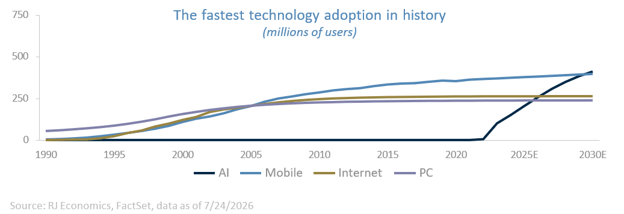
How do we know this technology is transformative? The answer is simple: We use it every day, often every hour. Another reason we believe AI deserves more attention than many previous technologies is the pace of adoption.
Historically, transformative technologies such as personal computers and the internet took many years to become widely used by households and businesses. AI is following a much steeper adoption curve as shown in the chart. Within just a few years of its public release, businesses and consumers have integrated AI into daily workflows at a pace that exceeds the early adoption of both PCs, mobile and the internet.
Why bubble fears are nothing new
The recent discussion about a potential AI bubble is not introducing a fundamentally new concern. Every major technological revolution attracts large amounts of capital, speculation, optimism, and sometimes, overoptimism. It is entirely possible that companies are overinvesting in AI infrastructure today. It is also possible that investors could become less enthusiastic if interest rates rise. And there is little doubt that the industry's eventual winners and losers will look very different from today's market leaders. Such outcomes are typical of technological revolutions.
History also reminds us that bubbles and transformational technologies are not mutually exclusive. The railroad boom of the nineteenth century experienced speculative excess yet railroads permanently reshaped commerce. The dot-com bubble ended painfully for many investors, but the internet ultimately transformed nearly every aspect of the global economy. Elevated valuations can coexist with revolutionary technologies. The existence of one does not invalidate the other.
For investors, the challenge is identifying the eventual winners. Easier said than done, of course. That may ultimately prove to be the most difficult part of investing in AI. While today's leading companies are investing billions of dollars in chips, data centers, software and talent, history suggests that some future winners may not even exist yet. In fact, many of the dominant internet companies today were either very small or not yet public during the late 1990s.
Bottom line
Our own view remains straightforward. We see the potential applications of AI as vast and transformative. That distinction helps explain why AI is attracting extraordinary levels of investment and attention. Whether this ultimately proves to be a bubble will depend on future returns and the industry's ability to deliver on its promises.
Another important distinction is that today's AI investment is not occurring in a vacuum. Companies across nearly every sector are actively searching for ways to improve productivity, reduce costs, automate repetitive tasks and augment their employees' capabilities. Unlike many speculative episodes, much of today's spending is tied to identifiable business objectives rather than purely financial speculation.
That does not eliminate investment risk, but it does provide a stronger economic foundation for the technology's adoption. For now, however, the opportunities created by AI appear far greater than those offered by previous technological revolutions, and that difference matters.
Will there be periods of excessive optimism? Almost certainly. Will some companies disappoint investors? Without question. But if AI ultimately delivers even a fraction of what expectations are today, its long-term economic impact could extend well beyond today's market cycle.
Economic and market conditions are subject to change.
Opinions are those of Investment Strategy and not necessarily those of Raymond James and are subject to change without notice. The information has been obtained from sources considered to be reliable, but we do not guarantee that the foregoing material is accurate or complete. There is no assurance any of the trends mentioned will continue or forecasts will occur. Past performance may not be indicative of future results.
