

Five key questions for third-quarter earnings season
Review the latest Weekly Headings by CIO Larry Adam.
Key takeaways:
- The consumer remains on solid footing despite building headwinds
- AI investment is likely to remain strong in the quarters ahead on robust demand
- Forward earnings estimates are supportive of the market
Third-quarter earnings season kicked off this week and expectations are high. Despite the headwinds of higher oil prices and interest rates, economic growth has remained resilient, while the AI investment boom continues to gain momentum. As a result, the S&P 500 is expected to deliver 29% year-over-year earnings growth, marking a third consecutive quarter of 25%+ gains. Notably, 2026 earnings estimates have risen 7.1% since the start of the quarter, defying the usual pattern of downward revisions. While hotter-than-expected inflation and recent semiconductor weakness have injected some volatility into the market, the broader backdrop remains constructive. Still, with expectations elevated, this earnings season will be an important test of whether corporate results can justify the strength of the broader economy. As we head into a busy eight-week stretch, here are the five key questions we're looking to answer.
Will the consumer remain resilient?
If the strong results from the mega-cap banks this past week are any indication, third-quarter 2026 earnings season should provide further evidence of a resilient consumer. Credit card spending remained robust at Citigroup (+13% year over year), Wells Fargo (+12% year over year), and JPMorgan (+10% year over year), while Delta Air Lines reported healthy travel demand despite higher airfares driven by surging crude oil prices. The key question is whether consumers can maintain that momentum as higher prices continue to pressure household budgets. So far, real-time indicators, including restaurant bookings, hotel occupancy, and department store spending, suggest demand remains solid. If that trend holds, it could provide a tailwind for the lagging consumer discretionary sector.
Will tech earnings stay on top?
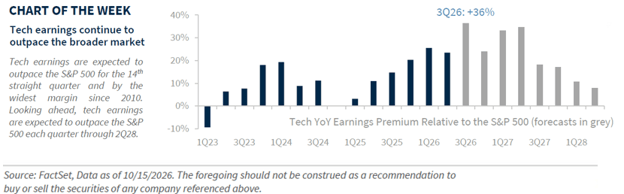
Tech earnings are expected to grow 64% year over year in 3Q26. While that's a modest slowdown from 73% growth in 2Q, it would still mark the 14th consecutive quarter of tech earnings outpacing the broader market, with the earnings premium (+36%) reaching its widest level since 2Q10. With tech margins 3x those of the rest of the S&P 500 and AI investment remaining on solid footing, tech earnings are expected to outgrow the S&P 500 each quarter through at least 2Q28. The key question is whether this earnings advantage can continue to support tech’s leadership as earnings growth moderates. We think it can. Constructive earnings, increasing shareholder-friendly activity and attractive valuations keep us overweight tech.
Can AI investment remain solid moving forward?
The slowdown in revenue growth at a major private AI company has raised questions about the staying power of the AI investment cycle. Given the scale of spending, those concerns are understandable. Still, the broader backdrop remains supportive. Hyperscalers remained capacity-constrained in 2Q26, and early 3Q26 supplier commentary points to the same trend, suggesting capex still has room to grow. Micron, for example, noted that demand for memory chips, a key AI input, continues to outpace supply. At the same time, AI adoption continues to broaden beyond tech. According to Ramp, business spending on AI reached a record high this week as 56% of businesses are now using AI, up from 44% a year ago. Adoption remains highest in the information sector (approximately 80% of firms), but other industries, such as accommodation and food (33%), health care (43%), and construction (43%), have increased AI usage by more than 10% over the past year. So, while volatility may remain elevated and headline-driven, the fundamentals still support strong hyperscaler spending and broader AI investment over the next 12 months. We expect that strength to show up in 3Q26 earnings and will be looking for clearer evidence that companies are translating AI investment into meaningful monetization.
Can earnings growth broaden amid higher rates and input costs?
Rising interest rates and higher energy prices were major themes throughout the third quarter. Early earnings reports have highlighted the impact, with both Pepsi and Delta raising prices to help protect margins. Even so, we expect earnings growth to broaden beyond tech, supported by sales growth that is projected to remain above 10% for a third consecutive quarter amid healthy business and consumer spending. In fact, nine of the 11 sectors are expected to deliver positive earnings per share (EPS) growth, while S&P 500 earnings ex-tech are projected to rise 17%, more than double the historical average.
Can 2027 estimates hold up?
With the US economy remaining on solid footing, technology's share of S&P 500 earnings is projected to rise to approximately 40% in 2027, up from 26% in 2026. At the same time, interest rates and energy prices are likely to ease in the months ahead, helping keep earnings estimates resilient. While the market will continue to lean heavily on technology, improving earnings growth across the rest of the index should provide an additional source of support. And although the pace of upward earnings revisions is likely to slow, we expect the overall fundamental backdrop to remain constructive, supporting our forecast for $385 in S&P 500 EPS over the next 12 months (through September 2027). That earnings outlook remains the foundation for our 12-month S&P 500 target of 8,450.
All expressions of opinion reflect the judgment of the author(s) and the Investment Strategy Committee and are subject to change. This information should not be construed as a recommendation. The foregoing content is subject to change at any time without notice. Content provided herein is for informational purposes only. There is no guarantee that these statements, opinions or forecasts provided herein will prove to be correct. Past performance is not a guarantee of future results. Indices and peer groups are not available for direct investment. Any investor who attempts to mimic the performance of an index or peer group would incur fees and expenses that would reduce returns. No investment strategy can guarantee success.
Economic and market conditions are subject to change. Investing involves risks including the possible loss of capital.
The information has been obtained from sources considered to be reliable, but we do not guarantee that the foregoing material is accurate or complete. Diversification and asset allocation do not ensure a profit or protect against a loss.
The S&P 500 Total Return Index: The index is widely regarded as the best single gauge of large-cap U.S. equities. There is over USD 7.8 trillion benchmarked to the index, with index assets comprising approximately USD 2.2 trillion of this total. The index includes 500 leading companies and captures approximately 80% coverage of available market capitalization.
Sector investments are companies focused on a specific economic sector and are presented here for illustrative purposes only. Sectors, including technology, are subject to varying levels of competition, economic sensitivity, and political and regulatory risks. Investing in any individual sector involves limited diversification.
