Understanding Premium Bonds
A bond priced at its face value or $100 is referred to as a par bond. Therefore, a purchase of a $1,000 face value bond at par would cost $1,000. A bond purchased or issued above $100 is a premium bond. For example, the purchase of a $1,000 face value bond at $104 would cost $1,040.
Why some bonds are priced at a premium? There is an inverse relationship between price and yield. As yields move up, prices go down. Conversely, as yields move down, prices go up. Once a fixed rate bond is priced and issued, its coupon is fixed and will not change. However, market interest rates change constantly, and price adjustments bring similar maturing/credit risk bonds to similar or matched values. If a bond is priced at par with a 5% coupon and interest rates fall to where new bonds are being issued with 4% coupons, the original bond will demand a higher price since it is offering a higher coupon. It would now be a premium bond. A portion of the cash flow on a higher 5% coupon is the premium being paid back. Mathematically, assuming rates remain constant, an investor holding a bond to maturity should be indifferent as to whether a premium, par or discount price is paid. (The example below is for illustrative purposes only.)
| Premium | Near Par | |
| Price | 117.5 | 99.01 |
| Face Value | $26,000 | $31,000 |
| Accrued Interest | $278 | $133 |
| Amount Invested | $30,830 | $30,826 |
| Yield-to-Maturity | 2.70% | 2.70% |
| Coupon | 6.25% | 2.5% |
| Maturity | 8/15/2023 | 8/15/2023 |
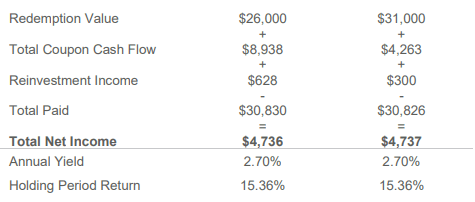
The yield-to-maturity assumes that the coupon received is reinvested at the purchase yield. In a rising rate environment with a standard upward-sloping yield curve (where short-maturity rates are lower than long-maturity rates), premium bonds will usually perform even better than par bonds, as the higher cash flows generated by higher coupons can be reinvested into the higher, rising interest rates.
The math intricacy and investor hesitancy toward premium bonds tend to lead to higher yields versus same credit quality, same maturity par bonds. This can result in even more favorable mathematical comparisons between premium and par bonds, where, over the same time horizon, premium bonds can produce higher investor returns. Therefore, the negative bias of some investors to premiums (due to accounting or arbitrary price limits) can sometimes lead to more attractive yields for investors.
Potentially lower price volatility is another benefit of premium bonds. Price volatility is one of the risks inherent in a security. Price volatility is the rate at which a bond price will move up or down as interest rates move. For a given change in interest rates, a premium bond will tend to rise or fall with less volatility versus the price of a par or discount bond of the same maturity. The following table illustrates two like maturity bonds where one is a high coupon premium and the other a zero (low) coupon discount. (The example below is for illustrative purposes only.
|
Premium1 |
Discount2 |
|||
| Rate Change | Price | % Change | Price | % Change |
| -2% | 148.99 | 16.63% | 92.64 | 20.89% |
| -1% | 137.88 | 7.93% | 84.23 | 9.92% |
| +1% | 118.51 | -7.23% | 69.74 | -8.99% |
| +2% | 110.07 | -13.84% | 63.50 | -17.13% |
1US Treasury 6.125% 11/15/27. 2 US Treasury 0.00% 11/15/27.
The coupon creates a buffer for price changes. Notice that under any rate movement, the premium bond has less price volatility. In the current interest rate environment, most investors are more concerned with rising interest rates. In this example, the premium bond is approximately 20% less volatile versus the zero coupon bond.
A call feature allows the issuers to “call” or redeem the bond prior to maturity. Most often, a call is at par; therefore, an investor would receive par dollars back on premium dollars paid. It is always prudent to evaluate the unique features of each bond and understand the significance of early redemption, especially noting the yield-to-worst when considering purchasing a bond.
Additionally, if interest rates fall during the holding period, an investor’s reinvestment of coupon cash flow will occur at lower, less rewarding rates. A premium bond will have a larger amount of coupon cash flow versus a par or discount bond.
Bond performance and yield-to-maturity calculations assume the reinvestment of coupon cash flow at rates equal to the purchase yield. The assumption is that the coupon is indeed reinvested. This is more impactful on premium bonds as the cash flow per pay period is greater.
Summary
- Premiums paid are dollars working for the investor. The premium comes back to the investor in the form of greater coupon cash flow versus a par or discount bond.
- Cash flow derived from premium bonds is greater versus par or discounted bonds. The reinvestment of cash flow can be a significant positive factor.
- Premium bonds are defensive in nature against rising interest rates. They tend to outperform par or discount bonds on an effective yield basis in a rising rate environment.
- Some investors set arbitrary limits on premiums paid thus creating market inefficiency. Understanding the advantages and the details of premium bonds presents the opportunity to take advantage of these inefficiencies.
- Under a normal upward sloping curve, premium bonds often yield more than par or discount bonds.
- Premium bonds are generally less price volatile, thus decreasing overall risk.
Note: The yield curve is a graphic depiction of the relationship between the yield on bonds of the same credit quality but different maturities.
The author of this material is a Trader in the Fixed Income Department of Raymond James & Associates (RJA) and is not an Analyst. Any opinions expressed may differ from opinions expressed by other departments of RJA and are subject to change without notice. The data and information contained herein was obtained from sources considered to be reliable, but RJA does not guarantee its accuracy and/or completeness. Neither the information nor any opinions expressed constitute a solicitation for the purchase or sale of any security referred to herein. This material may include analysis of sectors, securities and/or derivatives that RJA may have positions, long or short, held proprietarily. RJA or its affiliates may execute transactions which may not be consistent with the report’s conclusions. RJA may also have performed investment banking services for the issuers of such securities. Investors should discuss the risks inherent in bonds with their Raymond James Financial Advisor. Past performance is no assurance of future results.
This communication is intended to improve the efficiency with which Financial Advisors obtain information relevant to their client's taxable fixed income holdings. This information should not be construed as a directive from the RJ&A Taxable Fixed Income Department to buy or sell the securities noted above. Prior to transacting in any security, please discuss the suitability, potential returns, and associated risks of the transactions(s) with your client. For additional disclosure information on any security listed in this publication, please contact a Raymond James financial advisor.
Bond prices and yields are subject to change based upon market conditions and availability. If bonds are sold prior to maturity, you may receive more or less than your initial investment. Holding bonds to term allows redemption at par value. There is an inverse relationship between interest rate movements and fixed income prices. Generally, when interest rates rise, fixed income prices fall and when interest rates fall, fixed income prices rise.
The information contained herein has been prepared from sources believed reliable but is not guaranteed by Raymond James & Associates, Inc. (RJA) and is not a complete summary or statement of all available data, nor is it to be construed as an offer to buy or sell any securities referred to herein. Trading ideas expressed are subject to change without notice and do not take into account the particular investment objectives, financial situation or needs of individual investors. Investors are urged to obtain and review the relevant documents in their entirety. RJA is providing this communication on the condition that it will not form the primary basis for any investment decision you may make. Furthermore, because these are only trade ideas, investors should assume that RJA will not produce any follow-up. Employees of RJA or its affiliates may, at times, release written or oral commentary, technical analysis or trading strategies that differ from the opinions expressed within. RJA and/or its employees involved in the preparation or the issuance of this communication may have positions in the securities discussed herein. Securities identified herein are subject to availability and changes in price. All prices and/or yields are indications for informational purposes only. Additional information is available upon request.
Investment Products are: not deposits, not FDIC/NCUA insured, not insured by any government agency, not bank guaranteed, subject to risk and may lose value.
Find an Advisor
Connect with a Raymond James advisor or an office near you.