


Drive with caution, low visibility ahead (and behind)
Raymond James Chief Economist Eugenio J. Alemán discusses current economic conditions.
Our forecast for 2026 is for a strengthening US economy on the back of a strong fiscal spending profile due to the implementation of the One Big Beautiful Bill Act (OBBBA). This is the basis of our expectation for just one rate cut during the year, which is in line with the median dot plot from the latest (December 2025) Federal Reserve (Fed) Summary of Economic Projection.
But the road ahead for Fed policy makers is not quite what we thought it would be due to “low visibility” coming from economic data. To complicate matters for Fed policy makers, the continuously diverging signals from economic indicators still coming in from last year’s abnormal data release cycle due to the government shutdown are creating even more foggy conditions than normal data releases typically generate. These issues will keep monetary policy makers in the extremely cautious side.
This is why we have been surprised at some views from economists on the number of rate cuts for this year. Some economists are predicting up to three rate cuts during the first half of the year while Fed Governor Miran, during an interview on Thursday of this week, talked about 150 basis points cuts during 2026, something that, unless we see a serious deterioration in economic activity (that is, a recession) would be impossible to justify. When pressed on the subject, Governor Miran said that “if markets disagree with the Fed’s view, then we can make adjustments to our decisions” or something along those lines. The answer was in response to a question on “what if” markets disagree with the Fed and start pushing longer term rates higher, not lower, on the potential for higher inflation?
Miran further qualified his answer by saying that the intent of such a large rate cut was to help in the recovery of the US housing market. He added that, if they see that lower rates are helping other sectors that are not related to housing and they are crowding out lending to the housing sector, then the Fed could also adjust its policy to prevent higher lending in other sectors of the economy.
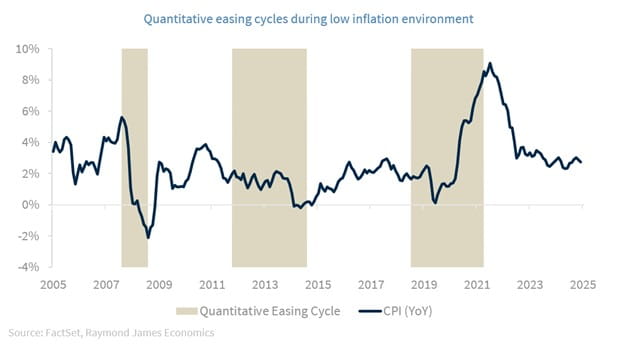
It would be interesting to see how such a policy could be implemented. Perhaps this is a hint that the Fed may have to start another quantitative easing (QE) cycle by buying both Treasuries as well as mortgage-backed securities (MBS) to help in lowering longer term interest rates, i.e., mortgage rates, which helped during the Great Financial Crisis as well as during the COVID-19 pandemic.
Late on Thursday, President Trump seemed to give a hint of what would happen if the Fed does not pursue another quantitative easing campaign. He said that he was “instructing” his representatives to buy $200 billion in mortgage bonds, that is, mortgage-backed securities, which is part of what the Fed bought during the last two crises.
The only things missing in this environment to help engineer another QE cycle are both a recession and substantially lower inflation than what we have today. But QE was not an instrument used for bringing longer term interest rates down, it was an instrument created, fundamentally, to bring inflation up to the 2% Fed target. With inflation entering its sixth consecutive year above the 2% target, there is no argument that could justify another QE cycle.
If we have a reduction of 150 basis points in the federal funds rate during the year and we do not have a recession, it will probably mean that the Fed has lost its monetary policy independence, something that is not impossible but would be extremely disruptive for the US economy, the US dollar and inflation.
At the end of Governor Miran’s interview he was asked if he was going to miss being part of the Fed and he surprisingly replied it was not part of his forecast, hinting at the possibility of staying at the Fed. Recall that when he was named last year he said he would fill the position temporarily after the resignation of Fed Governor Adriana Kugler. However, his answer during the interview sounded as if he is going to keep that position longer term. And while we don’t like to bet, if we had a $1 dollar to spare, we would bet that Governor Miran is in contention for being named the next Federal Reserve Governor!
Economic and market conditions are subject to change.
Opinions are those of Investment Strategy and not necessarily those of Raymond James and are subject to change without notice. The information has been obtained from sources considered to be reliable, but we do not guarantee that the foregoing material is accurate or complete. There is no assurance any of the trends mentioned will continue or forecasts will occur. Past performance may not be indicative of future results.